



A Gallabox Perspective
For sixteen years, WhatsApp has run on one identity system: your phone number. Every chat, every business conversation, every automated notification has been tied to a single piece of information you can never really change. That's finally shifting.
On June 30, 2026, WhatsApp confirmed it has begun letting people reserve unique usernames, ahead of a wider rollout that lets users be found and contacted by a handle instead of a phone number. The first country wave went live July 7, with Algeria, Azerbaijan, Ghana, Libya, and Nepal getting access, a second wave follows July 20, and the rest of the world is expected to roll out from September 2026 onward.
For a platform like Gallabox, built entirely around helping businesses run WhatsApp, Instagram, AI Voice, and Web conversations at scale, this is one of the more consequential changes to the ecosystem in years. Here's what's actually happening, and what it means for the businesses we work with.
What's changing, in plain terms
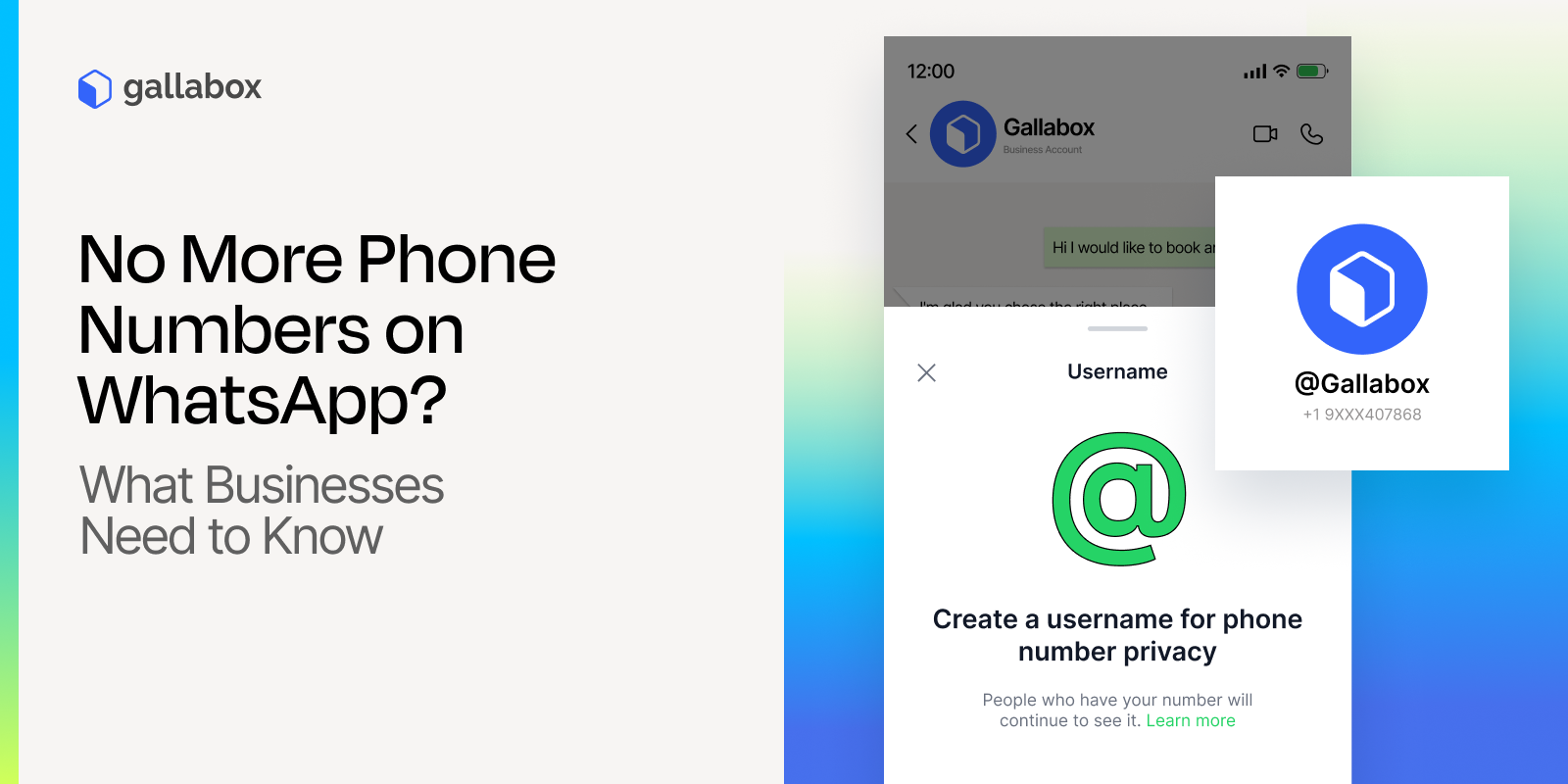
A WhatsApp username is an optional handle, something like @yourbrand, that a person or business can share instead of a phone number. Anyone who knows the handle can find that account inside WhatsApp and start a conversation. The phone number stays private and continues to power login, verification, and account recovery in the background.
A few rules are worth knowing:
- Handles must be 3 to 35 characters, contain at least one letter, and can't start with "www." or end in a domain like ".com"
- Only lowercase letters, numbers, periods, and underscores are allowed
- The username has to be unclaimed across Meta's platforms at once, so a handle already taken on Instagram or Facebook needs ownership verification before it can be used on WhatsApp
- There's no public directory and no autocomplete, so someone still needs to know the exact handle to reach an account for the first time
- WhatsApp is holding back handles that could be used to impersonate public figures, brands, or government entities
For businesses specifically, the display behavior is a little different from personal accounts. A verified business's phone number continues to show in chat, but the business also gets a unique, searchable username layered on top, designed to improve discoverability and brand recognition rather than replace the number outright.
.svg)
The part that matters most to anyone running WhatsApp API: BSUID
Behind the username feature sits a quieter but more important change for businesses: the Business-Scoped User ID, or BSUID. This is a new identifier that WhatsApp is introducing into webhook responses and API calls, meant to sit alongside phone numbers as the reference point for a conversation.
BSUIDs have already been present in webhook responses since March 31, 2026, and sending messages to a BSUID via the API has been supported since May 2026. That means every business running WhatsApp automation, CRM sync, chatbots, or reporting on top of phone-number-keyed data has some technical groundwork to do before usernames become the norm.
Concretely, this touches:
- CRM and contact records that currently treat phone number as the unique identifier
- Chatbot and automation logic that matches, routes, or personalizes based on number
- Reporting and analytics pipelines built around number-based conversation IDs
- Agent-facing dashboards that display contact identity to support and sales teams
Businesses using WhatsApp for customer service or marketing will need to update these systems to accommodate username-based connections rather than treating phone number as the only source of truth.
The reassuring part: nothing breaks overnight. Businesses that already have a contact's phone number from an existing conversation keep the ability to message that number directly, and users who choose not to adopt a username see no change at all to how their number is shared. The two identity systems coexist during the transition, which is exactly the kind of window that should be used to get infrastructure ready rather than waited out.
Why this is genuinely good news for businesses
It's easy to read "new API field to handle" as a compliance chore. We'd push back on that framing. A few real advantages show up here for businesses, especially the kind of mid-market and enterprise teams we work with across India and the GCC.
Branding finally travels with you, not your SIM card. A phone number tells a customer nothing. A username like @gallabox or @yourbrand is recognizable the moment someone sees it, and it can be identical to the handle a customer already knows from Instagram or Facebook. That consistency compounds every time someone sees the brand across channels.
Discoverability without an ad spend. Right now, the only way a new customer starts a WhatsApp conversation with a business is by already having its number, scanning a QR code, or clicking an ad. A claimable, searchable username opens a path where a customer who's heard the brand name can go find it directly inside WhatsApp.
Fewer typo'd or mis-saved contacts. Numbers get mistyped, saved under the wrong name, or lost when someone changes devices. A stable handle tied to a verified business account is far more durable, and it reduces the number of "wrong number" conversations that used to eat into support time.
A cleaner request-for-contact flow. WhatsApp's new native flow lets a business ask a customer to share their phone number and/or username through a proper in-chat request, rather than asking someone to type it out manually. That alone should reduce data-entry errors flowing into CRMs.
It closes a real trust gap. Customers have gotten warier of sharing personal numbers with unfamiliar brands. A username-first interaction, where the business is clearly identified and the customer isn't handing over a permanent identifier just to ask a question, lowers the friction of that first message.
How Gallabox is approaching this
As an omnichannel conversation platform spanning WhatsApp, Instagram, AI Voice Agents, and Web Agents, our job is to make sure this transition is invisible to the businesses we serve wherever possible, and valuable wherever it isn't.
That means:
- Making sure BSUID support is built into how we handle contact identity, so conversations, automations, and CRM sync keep working correctly whether a customer is identified by phone number, username, or both
- Helping businesses reserve and set up their own WhatsApp username through the same dashboard they already use for phone number and profile management
- Updating contact-matching logic so duplicate customer records don't start appearing as WhatsApp shifts from a single identifier to two
- Making sure agents and bots on the Gallabox platform can recognize and display username-based contacts correctly, so support and sales conversations don't lose context
- Keeping WhatsApp Marketing and CRM Sync workflows compatible with the native contact-request flow, so number and username sharing feed cleanly into existing customer records
What businesses should do between now and the global rollout
The rollout is staged deliberately, and that staging is the opportunity. A few practical steps for any business running WhatsApp conversations at volume:
- Audit where phone number is used as a hard-coded unique key across CRM, chatbot logic, and reporting
- Decide on a username early, ideally matching the handle already in use on Instagram and Facebook, since cross-platform consistency is part of the value and claiming clashes get harder as adoption grows
- Review chatbot flows to make sure they can handle a contact-request exchange gracefully rather than assuming a number is always available upfront
- Talk to your WhatsApp Business Solution Provider, Gallabox included, about BSUID readiness rather than assuming it's handled silently
- Treat the coming months as a testing window, not a deadline, since phone numbers aren't disappearing and the two systems will run side by side for a while yet
The bigger shift
WhatsApp has spent sixteen years as the messaging platform where your number was your identity, whether you liked it or not. Usernames don't just add a feature, they change what it means to "have a presence" on WhatsApp for a business. A phone number is something a customer has to already possess to reach you. A username is something a business can put on a billboard, a business card, an Instagram bio, or a Google result and let new customers come find it.
That's a meaningful shift from reactive to discoverable, and it's one we think plays especially well for the kind of businesses building real conversational relationships with customers across channels rather than treating WhatsApp as a single, isolated inbox.
We'll keep updating this as the rollout reaches India, UAE, and the rest of the GCC. If you run WhatsApp conversations through Gallabox, your BSUID readiness and username setup will show up in your dashboard as soon as your region is included in the wave.

.png)
Get your business on WhatsApp with Gallabox
Heading

A Gallabox Perspective
For sixteen years, WhatsApp has run on one identity system: your phone number. Every chat, every business conversation, every automated notification has been tied to a single piece of information you can never really change. That's finally shifting.
On June 30, 2026, WhatsApp confirmed it has begun letting people reserve unique usernames, ahead of a wider rollout that lets users be found and contacted by a handle instead of a phone number. The first country wave went live July 7, with Algeria, Azerbaijan, Ghana, Libya, and Nepal getting access, a second wave follows July 20, and the rest of the world is expected to roll out from September 2026 onward.
For a platform like Gallabox, built entirely around helping businesses run WhatsApp, Instagram, AI Voice, and Web conversations at scale, this is one of the more consequential changes to the ecosystem in years. Here's what's actually happening, and what it means for the businesses we work with.
What's changing, in plain terms
A WhatsApp username is an optional handle, something like @yourbrand, that a person or business can share instead of a phone number. Anyone who knows the handle can find that account inside WhatsApp and start a conversation. The phone number stays private and continues to power login, verification, and account recovery in the background.
A few rules are worth knowing:
- Handles must be 3 to 35 characters, contain at least one letter, and can't start with "www." or end in a domain like ".com"
- Only lowercase letters, numbers, periods, and underscores are allowed
- The username has to be unclaimed across Meta's platforms at once, so a handle already taken on Instagram or Facebook needs ownership verification before it can be used on WhatsApp
- There's no public directory and no autocomplete, so someone still needs to know the exact handle to reach an account for the first time
- WhatsApp is holding back handles that could be used to impersonate public figures, brands, or government entities
For businesses specifically, the display behavior is a little different from personal accounts. A verified business's phone number continues to show in chat, but the business also gets a unique, searchable username layered on top, designed to improve discoverability and brand recognition rather than replace the number outright.
The part that matters most to anyone running WhatsApp API: BSUID
Behind the username feature sits a quieter but more important change for businesses: the Business-Scoped User ID, or BSUID. This is a new identifier that WhatsApp is introducing into webhook responses and API calls, meant to sit alongside phone numbers as the reference point for a conversation.
BSUIDs have already been present in webhook responses since March 31, 2026, and sending messages to a BSUID via the API has been supported since May 2026. That means every business running WhatsApp automation, CRM sync, chatbots, or reporting on top of phone-number-keyed data has some technical groundwork to do before usernames become the norm.
Concretely, this touches:
- CRM and contact records that currently treat phone number as the unique identifier
- Chatbot and automation logic that matches, routes, or personalizes based on number
- Reporting and analytics pipelines built around number-based conversation IDs
- Agent-facing dashboards that display contact identity to support and sales teams
Businesses using WhatsApp for customer service or marketing will need to update these systems to accommodate username-based connections rather than treating phone number as the only source of truth.
The reassuring part: nothing breaks overnight. Businesses that already have a contact's phone number from an existing conversation keep the ability to message that number directly, and users who choose not to adopt a username see no change at all to how their number is shared. The two identity systems coexist during the transition, which is exactly the kind of window that should be used to get infrastructure ready rather than waited out.
Why this is genuinely good news for businesses
It's easy to read "new API field to handle" as a compliance chore. We'd push back on that framing. A few real advantages show up here for businesses, especially the kind of mid-market and enterprise teams we work with across India and the GCC.
Branding finally travels with you, not your SIM card. A phone number tells a customer nothing. A username like @gallabox or @yourbrand is recognizable the moment someone sees it, and it can be identical to the handle a customer already knows from Instagram or Facebook. That consistency compounds every time someone sees the brand across channels.
Discoverability without an ad spend. Right now, the only way a new customer starts a WhatsApp conversation with a business is by already having its number, scanning a QR code, or clicking an ad. A claimable, searchable username opens a path where a customer who's heard the brand name can go find it directly inside WhatsApp.
Fewer typo'd or mis-saved contacts. Numbers get mistyped, saved under the wrong name, or lost when someone changes devices. A stable handle tied to a verified business account is far more durable, and it reduces the number of "wrong number" conversations that used to eat into support time.
A cleaner request-for-contact flow. WhatsApp's new native flow lets a business ask a customer to share their phone number and/or username through a proper in-chat request, rather than asking someone to type it out manually. That alone should reduce data-entry errors flowing into CRMs.
It closes a real trust gap. Customers have gotten warier of sharing personal numbers with unfamiliar brands. A username-first interaction, where the business is clearly identified and the customer isn't handing over a permanent identifier just to ask a question, lowers the friction of that first message.
How Gallabox is approaching this
As an omnichannel conversation platform spanning WhatsApp, Instagram, AI Voice Agents, and Web Agents, our job is to make sure this transition is invisible to the businesses we serve wherever possible, and valuable wherever it isn't.
That means:
- Making sure BSUID support is built into how we handle contact identity, so conversations, automations, and CRM sync keep working correctly whether a customer is identified by phone number, username, or both
- Helping businesses reserve and set up their own WhatsApp username through the same dashboard they already use for phone number and profile management
- Updating contact-matching logic so duplicate customer records don't start appearing as WhatsApp shifts from a single identifier to two
- Making sure agents and bots on the Gallabox platform can recognize and display username-based contacts correctly, so support and sales conversations don't lose context
- Keeping WhatsApp Marketing and CRM Sync workflows compatible with the native contact-request flow, so number and username sharing feed cleanly into existing customer records
What businesses should do between now and the global rollout
The rollout is staged deliberately, and that staging is the opportunity. A few practical steps for any business running WhatsApp conversations at volume:
- Audit where phone number is used as a hard-coded unique key across CRM, chatbot logic, and reporting
- Decide on a username early, ideally matching the handle already in use on Instagram and Facebook, since cross-platform consistency is part of the value and claiming clashes get harder as adoption grows
- Review chatbot flows to make sure they can handle a contact-request exchange gracefully rather than assuming a number is always available upfront
- Talk to your WhatsApp Business Solution Provider, Gallabox included, about BSUID readiness rather than assuming it's handled silently
- Treat the coming months as a testing window, not a deadline, since phone numbers aren't disappearing and the two systems will run side by side for a while yet
The bigger shift
WhatsApp has spent sixteen years as the messaging platform where your number was your identity, whether you liked it or not. Usernames don't just add a feature, they change what it means to "have a presence" on WhatsApp for a business. A phone number is something a customer has to already possess to reach you. A username is something a business can put on a billboard, a business card, an Instagram bio, or a Google result and let new customers come find it.
That's a meaningful shift from reactive to discoverable, and it's one we think plays especially well for the kind of businesses building real conversational relationships with customers across channels rather than treating WhatsApp as a single, isolated inbox.
We'll keep updating this as the rollout reaches India, UAE, and the rest of the GCC. If you run WhatsApp conversations through Gallabox, your BSUID readiness and username setup will show up in your dashboard as soon as your region is included in the wave.
Get your business on WhatsApp with Gallabox
Get your business on WhatsApp with Gallabox
Related articles
Take Gallabox for a 7-day ride
.svg)


%201.webp)


